
India and Australia have signed significant agreements covering civil nuclear energy, maritime security, and critical minerals, reinforcing their partnership's role in ensuring a peaceful Indo-Pacific. The pacts facilitate uranium supply from Australia to India and enhance cooperation in defence, cyber, and critical technologies.

India and Canada solidify their partnership with a landmark uranium supply agreement and discussions to finalise a comprehensive economic partnership, signaling stronger ties and cooperation on key global issues.

An innovation roadmap, a mechanism to double annual bilateral trade within next five years, and a joint artificial intelligence framework were among 13 outcomes to emerge from wide-ranging talks between Prime Minister Narendra Modi and President Emmanuel Macron on Sunday.

Pakistan, Saudi Arabia and Turkiye on Friday signed a key joint defence agreement under which an attack against one of them will be treated as an attack against all of them, amid increasing security concerns in the wake of escalating tensions in West Asia.

Iran has put forward a comprehensive 10-point framework that it says forms the basis of a complete resolution.

The demerger of Vedanta's four new entities - Vedanta Aluminium Metal, Vedanta Oil & Gas, Vedanta Power, and Vedanta Iron & Steel - has led to a 16% appreciation in aggregated market capitalisation, with Vedanta Aluminium Metal identified as a likely near-term top performer due to its scale, low production costs, and favourable commodities cycle.

Russian President Vladimir Putin is set to visit China for talks with Chinese leader Xi Jinping, shortly after US President Donald Trump's visit to Beijing. The visit underscores the close strategic ties between China and Russia amid global tensions.

Chinese Foreign Minister Wang Yi has urged Iran to guarantee freedom and safe passage through the Strait of Hormuz, a critical waterway for global oil trade, amid ongoing tensions with the US.

For weeks, the war skirted the edge of catastrophe without tipping over. Missiles flew, there was much destruction, commanders were assassinated, cities across the Gulf and even in Israel struggled to absorb the shock. But one line held: Energy infrastructure, the arteries of the global economy, remained largely untouched. That is no longer true. Prem Panicker continues his must read daily blog on the Gulf War.
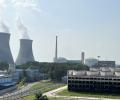
Ushering in reforms, Union Finance Minister Nirmala Sitharaman on Saturday proposed to open up the nuclear power sector for private players and announced a Rs 20,000 crore Nuclear Energy Mission for research in the field, with an aim to set up five small and modular reactors by 2033.
India on Saturday announced plans to amend its nuclear liability law and set up a nuclear energy mission, a move that came ahead of Prime Minister Narendra Modi's likely visit to the United States.

Pakistan's Chief of Defence Forces Field Marshal Asim Munir held talks with Iranian leaders in Tehran to help resolve the conflict between the US and Iran, following a recent ceasefire agreement.

Chinese President Xi Jinping warned US President Donald Trump that mishandling the Taiwan issue could trigger conflicts between the two countries during wide-ranging talks on trade, Iran, and energy security.

India is also likely to push for a Free Trade Agreement with the Eurasian Economic Zone and is sharing details of the study it conducted in this regard.

A Pakistani delegation, led by Army Chief Field Marshal Asim Munir, has arrived in Tehran to mediate the ongoing conflict between the US and Iran, following initial talks in Islamabad.

The United States and Iran could resume negotiations as early as next week in Islamabad, according to a report by The Wall Street Journal citing people familiar with the matter.
Direct talks between the US and Iran, mediated by Pakistan, have failed to produce an agreement after 21 hours of negotiations, with disagreements over Iran's nuclear ambitions and sanctions proving insurmountable.
This is the time for India to plan forward fully, with the goal of Atmanirbharata, and energy security. The Persian Gulf is no longer a reliable source, points out Rajeev Srinivasan.
US Vice President JD Vance is set to arrive in Islamabad on Monday evening to lead a high-level American delegation in a second round of ceasefire negotiations with Iran, CNN reported, citing White House on Sunday.

US-Iran talks in Islamabad collapsed after 21 hours, exposing deep divisions over nuclear ambitions and sanctions.

Pakistan is playing a key role in facilitating talks between the US and Iran, but the future of these negotiations remains uncertain. Despite ongoing diplomatic efforts, no dates have been set for a second round of discussions.

If one has to compare the tenures of the two prime ministers one must credit Nehru with laying the foundations on which Modi is building a grand edifice, asserts Colonel Anil A Athale (retd).

The Iranian Foreign Ministry has stated that Tehran currently has no plans for a subsequent round of negotiations with the United States, according to the state media Tasnim news agency. This announcement comes as international mediators had hoped for a follow-up to the Islamabad talks before the looming ceasefire deadline.

Scientists at CERN have achieved a groundbreaking feat by successfully transporting antimatter across their Geneva laboratory, opening new avenues for antimatter research and potentially shedding light on the universe's matter-antimatter imbalance.

As the negotiations continued, the Iranian government said on social media that "talks between Iran and the US in Islamabad entered the expert-level stage as economic, military, legal, and nuclear committees joined in".

Prime Minister Narendra Modi stayed calm, avoided public confrontation, and focused on India's long-term interests to steady ties with the United States.

Addressing a joint media event with Macron, Modi said the two countries have robust cooperation in the fields of defence and security.
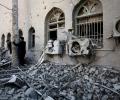
The logic of war plus the gathering storms in US politics as the midterms loom large leave him with no real alternative but to negotiate, points out Ambassador M K Bhadrakumar.

The fragile ceasefire in West Asia between the US and Iran to halt the hostilities in the region for two weeks faces renewed uncertainty as Tehran reportedly moved to block the strategic Strait of Hormuz once again due to Israel's intensified offensive against Hezbollah in Lebanon, according to Iranian state media Islamic Republic News Agency (IRNA), which US President Trump says was "not included" as part of the ceasefire deal.

Trump has made it clear: the US will not lift its blockade of Iranian ports until a deal is signed.

Alliances fight wars effectively only when they share an endgame. If Israel acted without US knowledge, then the military alliance is operating without real coordination at the level of strategic targeting. Neither picture is reassuring in a war that is no longer regional in its consequences. Prem Panicker continues his must read daily blog on the Gulf War.

There are enough people at the top decision-making level in Tehran who are still willing to negotiate, provided Trump can create the right setting for the negotiation to acquire a dynamic of its own, points out Ambassador M K Bhadrakumar.

Pakistan's Prime Minister Shehbaz Sharif has offered to host talks between the US and Iran to help resolve the ongoing conflict in the Middle East, following reports of Pakistan's involvement in backchannel diplomacy.

The delegations from the US and Iran head to Islamabad on Friday, carrying a ceasefire that is already fraying, a Strait that is technically open and practically closed, and a negotiating agenda that would challenge even parties actually negotiating in good faith, which these groups are not. Prem Panicker continues his must read blog on the Iran War.

The West Asia conflict escalated sharply as Iran launched missiles towards Israel, while Tehran confirmed the killing of its intelligence minister in Israeli strikes, marking the third assassination of a senior Iranian official in two days.

Pakistan is set to host face-to-face talks between the United States and Iran, aiming to solidify a fragile ceasefire and prevent further conflict in West Asia. The discussions will focus on a long-term peace arrangement, including sanctions relief, regional security, and Iran's nuclear program.

Iran has announced the Strait of Hormuz is open to commercial vessels, coinciding with a ceasefire between Lebanon and Israel.

Trump may strike. He may announce productive talks and extend again. He may do both at the same time. Iran will not open the Strait on someone else's terms, so no matter what happens, that problem will remain unsolved. And the IRGC will still be collecting its $2 million toll from every ship bold enough to ask permission to pass.

'American stature has been reduced because they have not been able to achieve their aims.'

The ceasefire is still technically holding, to the extent that no overt hostilities have been reported yet, but the rhetoric has hardened dangerously. The week ahead will also clarify whether the Islamabad failure was a negotiating tactic or whether Washington has genuinely locked itself into a position from which the only exits are climb-down, escalation, or the slow bleed of a new status quo that nobody chose and nobody controls. Prem Panicker continues his must read blog on the Iran War.
